

Inside Nunavut’s first factory, an Inuit-led approach to advanced manufacturing is creating more than homes. It’s building skills, careers and new possibilities for the community.
On September 29, hundreds of people gathered in Arviat, Nunavut, to celebrate a first for the territory: the grand opening of the Sakku Innovative Building Solutions (SIBS) modular housing facility.
Families, children, Elders, employees, community leaders and project partners filled the celebration. The day included a qulliq lighting, throat singing, traditional drum dancing, a ribbon-cutting, factory tours, music and a community barbecue.
But what stood out most wasn’t the size of the new facility or the production equipment inside it.
It was the sense of pride surrounding it.
People toured the production floor, met the employees who will work there and gathered around as community and project leaders signed the factory’s first build. There was a sense that this facility belonged in Arviat and that the opportunities created inside it could extend well beyond the homes it produces.
Built in Arviat, for the North
Building housing in Nunavut comes with challenges that are difficult to appreciate from southern Canada. The construction season is short, materials and labour often need to travel long distances, and weather can dictate when work gets done.
SIBS changes that equation.
The 64,500-square-foot, 100% Inuit-owned facility brings homebuilding indoors, allowing modular housing to be manufactured throughout the year in Arviat. At full capacity, the factory is expected to produce up to 40 homes annually while supporting more than 40 direct jobs and over 100 indirect jobs through transportation, installation and other supply chain activities.
Much of the construction can now happen inside the factory before modules are transported for installation, allowing SIBS to make better use of Nunavut’s short construction season.
And the impact will begin close to home. The factory’s first planned production includes nine three-bedroom homes for Arviat, purchased by the Kivalliq Inuit Association.
For SIBS CEO Caroline Nault, the ability to manufacture year-round changes more than the production schedule.
Nault explained that bringing construction indoors provides a safer, more consistent environment for employees to learn their trades. It also allows modules to be ready when Nunavut’s short installation season begins, creating the potential to get more homes completed and ready for families.
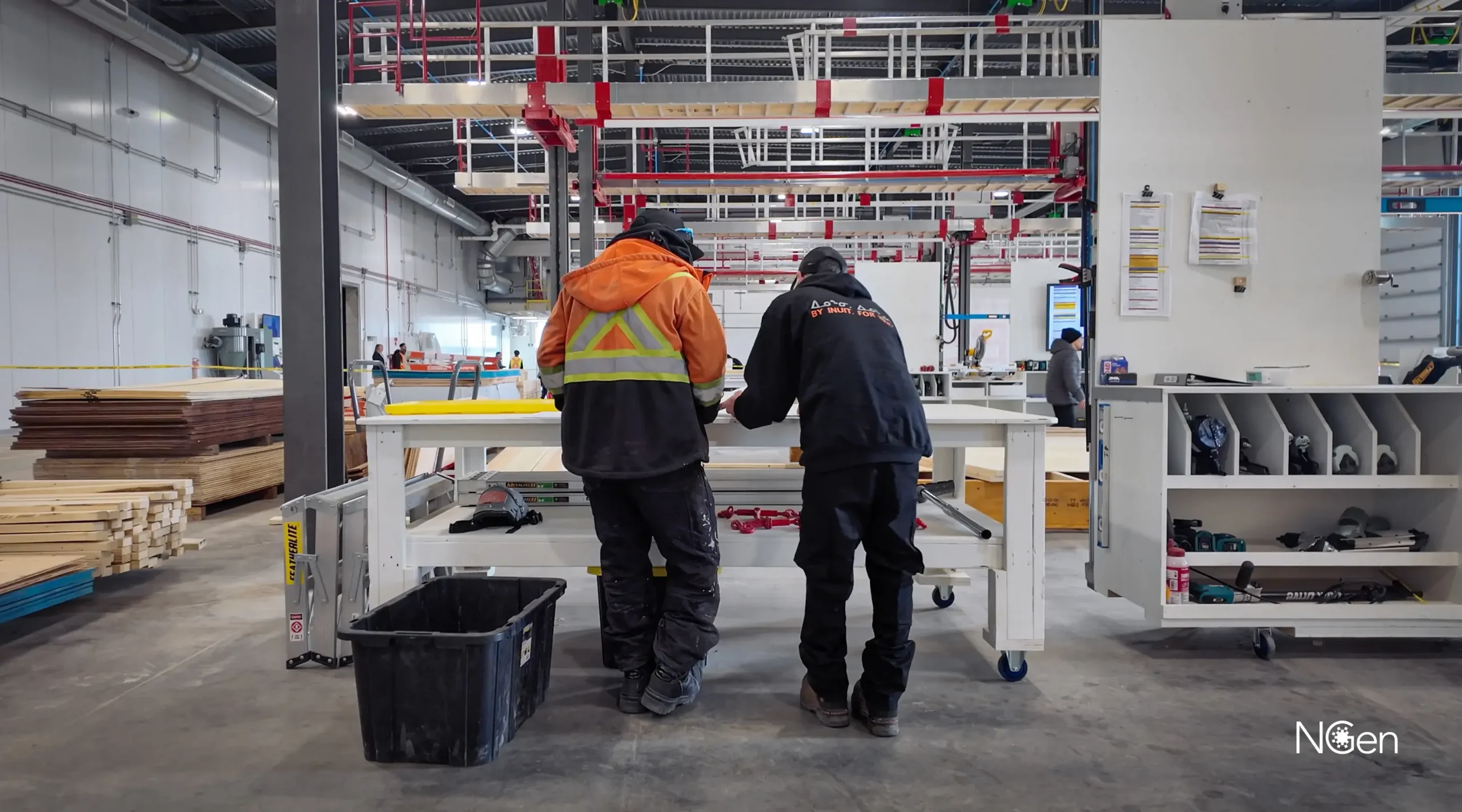
SIBS employees at work inside the new facility, where year-round production is creating opportunities to build skills and careers locally.
Building people alongside homes
The workforce component has been part of the vision from the beginning.
Approximately 93 per cent of SIBS’ current workforce is Inuit, and employees are developing hands-on skills across carpentry, electrical, plumbing, mechanics and cabinet assembly.
For Nault, Inuit ownership is about self-determination, with Inuit leadership shaping the project, developing the workforce to support it and keeping more of the resulting economic activity in Nunavut.
“It’s having Inuit leadership in the project and having houses built by Inuit for Inuit.”
Her definition of success five years from now goes well beyond a full production calendar. It’s also about developing a workforce with skills that employees can carry throughout their careers, whether they remain with SIBS or take those skills to other employers.
That possibility is particularly important for younger people in the community.
Arviat Mayor Joe Savikataaq Jr. sees the factory as a chance for young Inuit to see opportunities that may not have seemed possible before.
“It will be an eye-opening experience for them to actually see a product being manufactured on our homeland that will be used by families in the North.”
Those opportunities could mean entering a trade, working in manufacturing, supporting local businesses or eventually starting businesses of their own.
The factory doesn’t just increase Nunavut’s capacity to build homes. It helps develop the skills, experience and local capacity that can support a broader northern economy.
Strengthening a partnership and building capacity
Getting to this point required more than technology or investment alone.
Sakku brought the vision, Inuit ownership and deep connection to the community. RG Solution brought decades of modular manufacturing expertise from Quebec. NGen helped strengthen that existing partnership and accelerate the broader benefits the project had the potential to create.
Through its Advanced Manufacturing Homebuilding Challenge, NGen contributed $3.4 million toward a $9 million advanced manufacturing project, supporting the installation and operationalization of specialized production cells and advanced manufacturing equipment.
For Robert Mastrotto, NGen’s Vice President of Projects, what makes the project particularly significant is how that manufacturing capability connects to a much bigger community need.
“It’s solving a problem bigger than technology. It’s solving a problem within a community.”
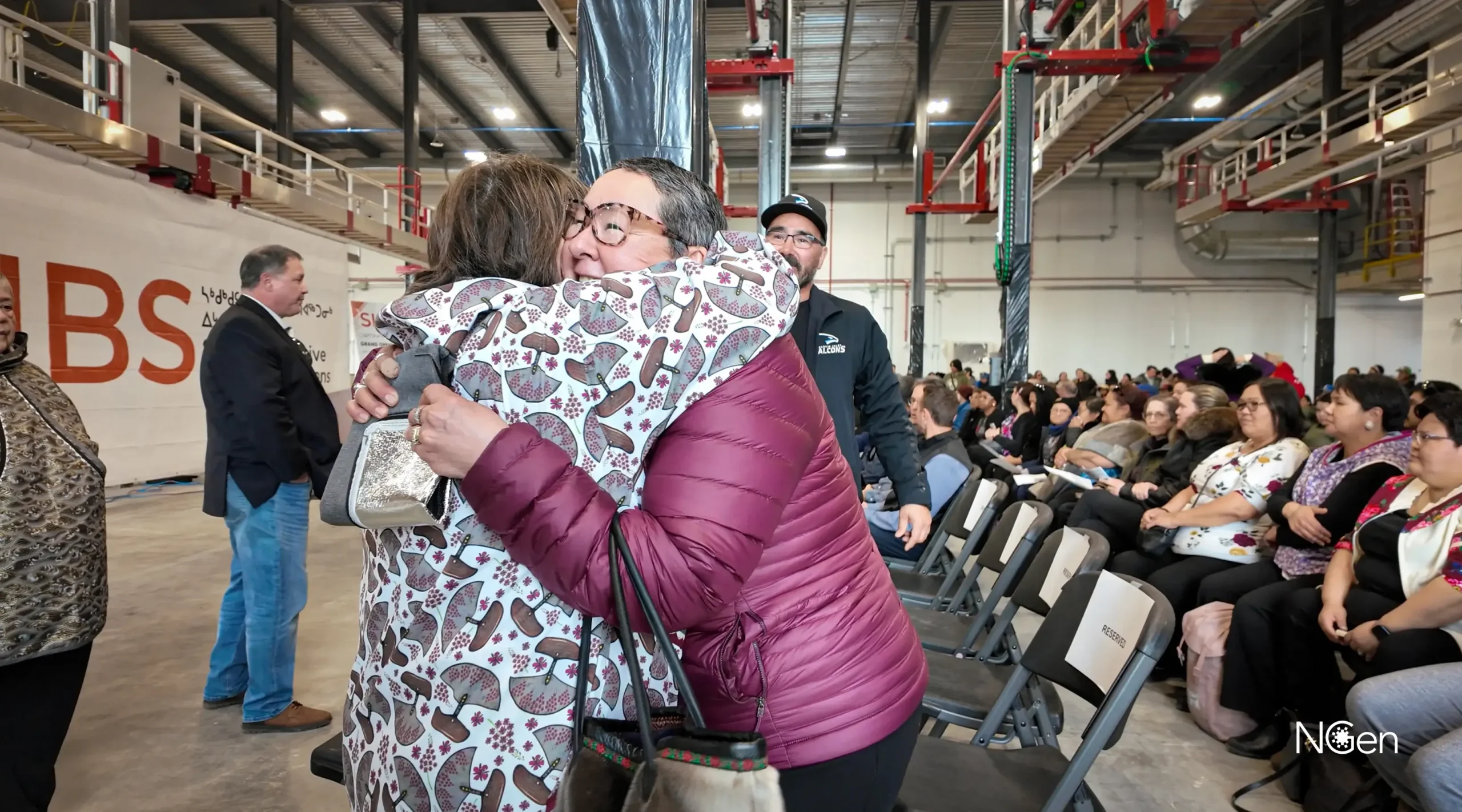 Community members gather inside the SIBS facility to celebrate a milestone years in the making.
Modern production systems, automation and modular manufacturing expertise are all part of the equation. But so are the people who will operate those systems, develop new skills and use that capability to build homes for communities across the North.
That’s what makes the project such a powerful example of advanced manufacturing in action.
From an idea to the first build
During the grand opening, community and project leaders gathered to sign the factory’s first build, a symbolic moment marking the transition from years of planning and construction to actual production.
For Nault, seeing that transition become real was one of the proudest moments of the day.
“A few years ago it was only a dream and now we deliver on what we said.”
The factory began production in September 2026, initially operating three production cells with plans to scale to five.
What happens next could extend well beyond those production cells.
SIBS has the capability to manufacture single-family homes, multiplexes, staff housing, commercial buildings and other community infrastructure. Its operations can also create opportunities for local tradespeople, transportation providers, installation crews, suppliers and other businesses.
For Mastrotto, establishing that capability in Arviat also demonstrates something important about where advanced manufacturing can happen in Canada.
“This model shows… it can be done across the country. It can be done in northern regions, it can be done in cities, it can be done really across Canada.”
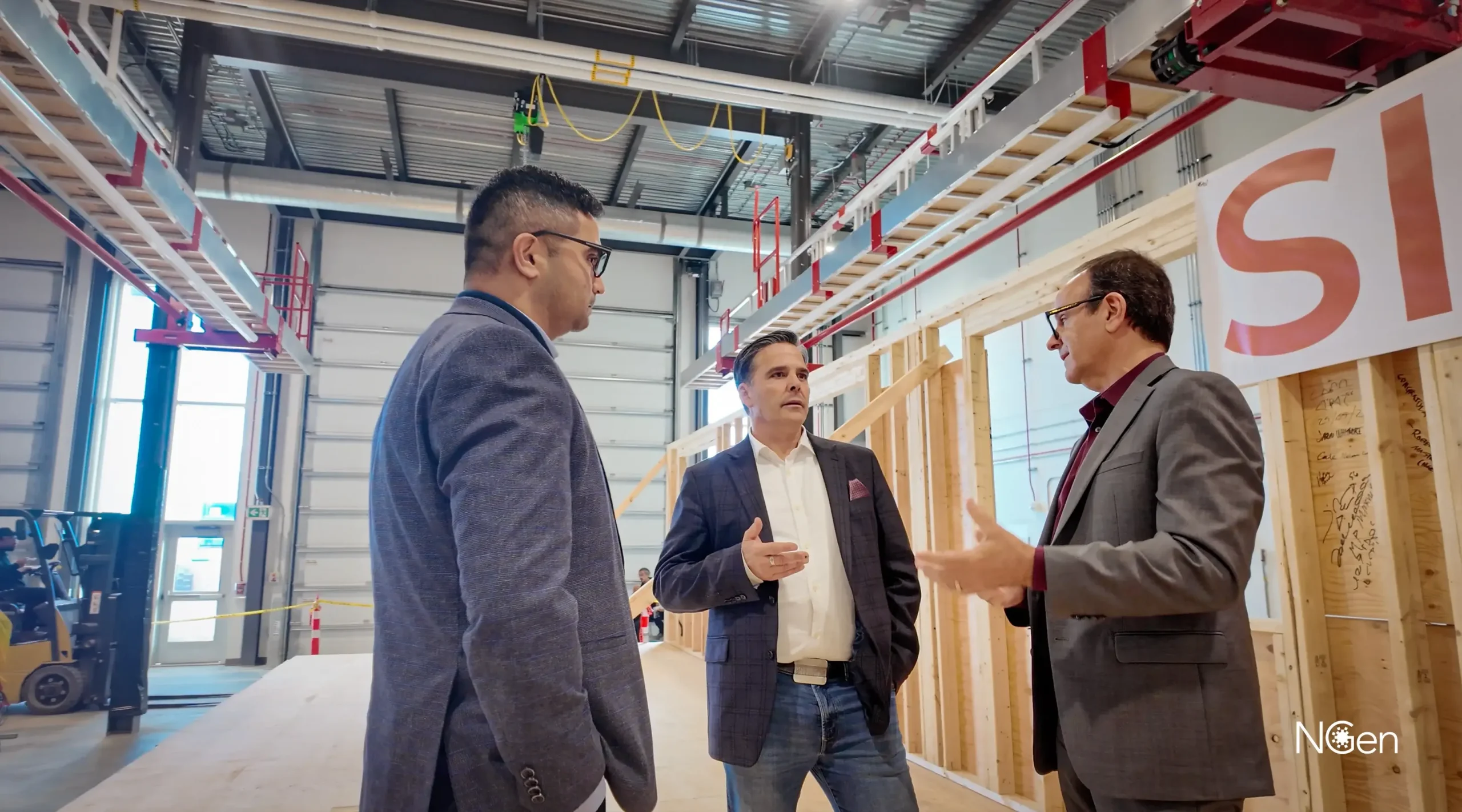
NGen’s Robert Mastrotto and Aakash Rao tour the new SIBS facility with RG Solution’s Stéphane Dufresne, whose team brought its modular manufacturing expertise to the partnership.
Planting something that can grow
At the grand opening, Mayor Savikataaq described the factory using a simple analogy.
“It’s like a seed.”
What has been planted in Arviat, he said, can reproduce again and again, allowing more people to benefit from what began here.
That idea captured much of what could be felt throughout the grand opening.
The production cells and equipment matter. So do the homes that will leave the factory.
But the lasting impact of SIBS may ultimately be measured just as much by what stays in Arviat: skills, careers, expertise, businesses, opportunity and the confidence that something ambitious can be built here.
A few years ago, this factory was an idea.
Today, it’s building homes.
And Arviat is building something much bigger alongside them.
Story and photography by Nelson Netzereab, Digital Marketing Manager, NGen
Read More Here: https://www.ngen.ca/blog-2026/building-a-future-in-arviat